Choose the Australian companies you want as clients. We'll start the conversation for you.

A pipeline of real sales conversations, built over 90 days. Not by posting every day, not by spending more on ads, and not by hiring a salesperson and hoping they work out.

338 contacts. 15 meetings booked. $185,000 in pipeline. Four new clients in 40 days.

Selected B2B clients and partners Damien has worked with

For Australian B2B businesses with 5 or more staff and an average deal worth having.

See if it works in your market

5 questions, about a minute. No obligation.

The short version

What it is
You pick the Australian companies you want as clients. We start the conversation with a real email signed by you.
Who it's for
Australian B2B, 5+ staff, a new client worth roughly $15,000 or more, and somebody at your end who can pick up a warm reply.
What you get
The targeting, sending infrastructure, messaging and every reply handled. You only hear from people who want a conversation.
What you approve
The list and the messages, before anything sends. Your main domain never sends a cold email.
What happens next
A 5 question application, then a 30 minute call. I'll tell you whether I think it'll work and give you the price.
Commitment
The initial Sprint is 90 campaign days. After that it's month to month. If you stop, the domains, inboxes, campaigns and data are yours to keep.
Apply for a call

You'll get the price on that first call.

If you'd rather understand how it works before you talk to anyone, keep reading. The rest of this page is the how.

A quick fit check

This fits if

You're an Australian B2B business with 5 or more staff, a new client is worth roughly $15,000 or more, and somebody at your end can pick up a warm reply within a few days.

It doesn't fit if

You sell to consumers, you want a spreadsheet of names, or nobody at your end can respond to interest quickly.

If that's not you, I'd rather say so here than on a call.

If your pipeline runs on referrals and hope, give me ten minutes and I'll show you something better.

I'm Damien Elsing. I've spent more than ten years building lead generation and revenue systems for B2B companies, and I want to talk to you about the one channel where you actually get to choose who hears from you.

Because right now you probably can't. You run a good business, you're good at the work, and that's never really been the problem. The problem is that the work only turns up when somebody remembers to send it your way. Some months the calendar is full and you're wondering how you'll deliver it all, and some months you're refreshing your inbox like it owes you money.

You pick the companies. We start the conversation.

This is the only channel in your marketing where the targeting is a decision you make rather than an outcome you wait for.

We work out exactly which Australian companies you want as clients. Not a vague buyer profile, but a list of named companies chosen because winning one would be worth having. You approve that list. Then we start the conversation, one company at a time, with an email to a named person about their actual business, sent on your behalf and signed with your name.

When you run an ad, the platform decides who sees it. You sort whatever comes back. Outbound reverses that order. The only people who see your message are at companies on the list you approved. When somebody replies with interest, they're already a company you wanted. The qualification happened before the email was ever sent. You're not sorting through interest to find fit. Fit was the entry requirement, which is why these conversations tend to move faster and close better than anything that came in through the front door.

Advertising versus outbound: where the sorting step sits Two lanes with identical parts. In the advertising lane the message is sent to the whole market and the sorting happens afterwards on mixed replies. In the outbound lane the sorting happens first, so the message only goes to chosen companies and every reply is one you wanted. ADVERTISING MESSAGE SENT YOU SORT THE REPLIES Your market Mixed replies Worth having You message the whole market, then sift through whatever comes back. OUTBOUND YOU SORT THE MARKET MESSAGE SENT Your market Only these Worth having You sort first, so the only people who ever hear from you are ones you chose.
Advertising versus outbound: where the sorting step sits Two vertical lanes with identical parts. In advertising the message is sent first and sorting happens afterwards on mixed replies. In outbound the sorting happens first, so only chosen companies ever receive the message. ADVERTISING Your market MESSAGE SENT Mixed replies YOU SORT THE REPLIES Worth having OUTBOUND Your market YOU SORT THE MARKET Only these MESSAGE SENT Worth having Both lanes end the same way. Only one of them paid to message a whole market to get there. The blue box is the only thing that moved.

Nothing goes out with your name on it until you've approved it

You approve the companies, the messages and real samples of what will land in an inbox.

Your name is on every message, not ours. You can strike any company from the list. You see the messaging and representative samples before launch. Your main domain never sends a cold email because we build separate infrastructure and keep the risk away from the address your invoices go out from.

The out-of-offices, wrong people, not-interesteds and removal requests are handled at our end. You or whoever runs sales only hears about people who are qualified and want a conversation.

I'm telling you this here rather than burying it near the bottom because it should change how you read the rest of the page. There's nothing in this that happens to you. It happens with you, and the parts that could embarrass you are the parts you sign off on.

338 contacts became 15 meetings and $185,000 in pipeline

One B2B software campaign produced four new clients inside its first 40 days.

We built a list of 338 people. Every one was at a company the client had agreed they wanted.

Cold email campaign dashboard showing 338 contacted, 288 opened, 98 replied and 37 opportunities.
One client campaign. 338 contacted.

288 opened the email, which is 85 percent. 98 replied. 37 of those replies were people saying yes, they were interested. That turned into 15 booked meetings, $185,000 in pipeline and four new clients inside the first 40 days.

Calendar screenshot showing 15 meetings booked.
15 meetings booked.

A digital agency won three new clients within a month. A recruitment firm signed six clients from twenty positive replies inside the first fifteen days, and ten in total.

Those are real numbers from real campaigns. They're not a forecast. I don't know your market, offer or deal size yet. They show what can happen when the pieces line up.

See if your market looks like this

5 questions, about a minute.

Why it probably didn't work the last time you tried

Until recently, outbound made you choose between relevance and volume, and you could only ever have one.

Content, SEO, ads, referrals, speaking gigs, awards. They all work the same way underneath. You put something out into the world and wait for the right person to find it at the right moment. That's fine when you've got time, and useless when you need pipeline in March.

The alternative is that you pick the companies you want and go and talk to them. Once you've said that out loud, the obvious question is why isn't everyone doing it.

You could have relevance, which means a real person doing real research and writing something that shows they understand your world. That works brilliantly. It also takes about twenty minutes an email, so you'll manage forty a week before somebody burns out or quietly starts cutting corners.

Or you could have volume, which means ten thousand emails before lunch. Cheap, tireless and completely blind. It doesn't know that company just raised money, it doesn't know the person it's writing to left in March, and it doesn't know that the personalised line it just wrote is quietly humiliating you.

Every method you've heard of picked a side. The agencies faked relevance with templates and hoped volume would cover the difference. The AI tools picked volume and called it innovation. A BDR hire picks relevance and then drowns in it, and you get to watch that happen at considerable expense. If you've tried outbound before and it went nowhere, that's almost certainly why. The channel wasn't the problem. You were handed one half of a two part job and charged for the whole thing.

What the other options actually cost you

A BDR costs north of $110,000 a year. A cheap agency costs $1,500 a month and skips the two expensive parts.

You've probably priced at least one of these, so it's worth being honest about all three.

Hiring a BDR costs you north of $110,000 a year once you've paid salary, super, tools, data and the ramp up months where they're learning your market. You've also taken on a management job. Somebody now has to coach them, review their calls, keep them motivated and tell you honestly whether it's working, which is a hard thing to be objective about with a person you like. What we do costs a fraction of that, and nobody has to have the difficult conversation.

A cheap agency runs around $1,500 a month and buys you a template, a list somebody else also bought, and a monthly report with encouraging graphs on it. It's cheap because nobody is doing the two expensive parts, which are choosing the right companies and making sure the email arrives.

Doing it yourself is what most founders try first. Three to five cold emails a week between everything else, or forty a day for about three weeks if you're disciplined. Then a big project lands, it stops, and it never quite starts again. That's not a discipline failure. It's what happens when the person doing outreach is also the person delivering the work.

AI can now judge a whole market, not just spray it

The useful change is the ability to apply approved judgement across thousands of companies.

A person still decides the audience, angle, proof and ask. AI can then read the market, sort companies into priority tiers and apply the right approved variation to each segment. The top tier gets deeper research. Companies that don't belong come out before anything sends.

Priority Tiers: effort follows value A large market is sorted into three tiers. Bad fits are removed before anyone writes. Best fits receive real individual research. Good fits receive an opening line written about their own business. YOUR MARKET Everyone who could plausibly fit BAD FITS Removed before anyone writes a word BEST FITS Real research, written one at a time GOOD FITS An opening line about their own business Effort follows value. Nobody gets a template.
Priority Tiers: effort follows value A large market is sorted into three tiers. Bad fits are removed before anyone writes. Best fits receive real individual research. Good fits receive an opening line about their own business. YOUR MARKET Everyone who could plausibly fit BAD FITS Removed before anyone writes a word BEST FITS Real research, written one at a time GOOD FITS An opening line about their own business Effort follows value. Nobody gets a template.

We call that Priority Tiers, and it isn't a clever idea so much as a thing that was impossible at any scale two years ago. Effort follows value. It's why we no longer have to choose between reaching your whole market and saying something worth reading.

The three things that decide whether this works

Audience, inbox and message multiply. A zero anywhere and the other two are worth nothing.

The right audience means the right people at the right companies with a defensible reason to hear from you. The right inbox means the email actually arrives somewhere a human will see it. The right message means it reads like something a person would send. We call it AIM.

Audience times Inbox times Message equals Conversations The three factors multiply rather than add. A zero on any one of them makes the result zero. AUDIENCE × INBOX × MESSAGE = CONVERSATIONS 10 × 10 × 10 = 1000 10 × 10 × 0 = 0 0 × 10 × 10 = 0 They multiply, they do not add. A zero anywhere and the other two are worth nothing.
Audience times Inbox times Message equals Conversations The three factors multiply rather than add. A zero on any one makes the result zero. AUDIENCE × INBOX × MESSAGE = CONVERSATIONS 10 × 10 × 10 = 1000 10 × 10 × 0 = 0 0 × 10 × 10 = 0 A zero anywhere and the other two are worth nothing.

The important part is that these three don't add up, they multiply. Get a zero on any one of them and the other two are worth nothing. Perfect copy sitting in a spam folder is worth nothing. Flawless delivery to somebody who signed with your competitor last quarter is worth nothing. A brilliantly chosen list, written to badly, is worth nothing.

Find out how your market scores

5 questions, about a minute.

Audience: deciding exactly who hears from you

Bad fits, current customers, existing opportunities and do-not-contact records come out before launch.

We map the companies that fit, remove exclusions and sort the rest by what a win would be worth. The best fits get deeper research. Everyone who belongs gets an opening based on their business rather than their first name dropped into a template.

The earlier campaign is a useful illustration. 338 people, 98 replies, 37 interested. You don't get numbers like that from a bigger list. You get them from a smaller one somebody chose properly.

Inbox: making sure the thing actually arrives

Most failed cold email campaigns fail here, quietly, because nobody was watching the right screen.

Before a single email sends, we build separate domains so your main one never sends a cold email. We use real Microsoft 365 inboxes, configure DNS, warm them slowly and monitor them every day.

Setup normally takes 10 to 15 business days. That's an expectation, not a promised launch date. I'd rather start late than rush warm up and spend the first month on damaged infrastructure.

No provider on earth can promise perfect inbox placement. Email providers make their own decisions and don't publish the rules. What we can promise is that somebody watches the numbers and slows the sending when they say to.

Message: sounding like you, across a whole market

We write the core message with you, then AI applies approved variations where they fit.

Your name is on every message, so here's the test we hold ourselves to. Would you be embarrassed if a competitor read what we sent on your behalf? That question kills most cold email templates on sight, and it should.

We build the angle, opening, hook, proof, objection and ask with you. You approve them and real samples. AI then sorts the market, matches the approved version to the right buyer and writes an observational opening based on what the company actually does.

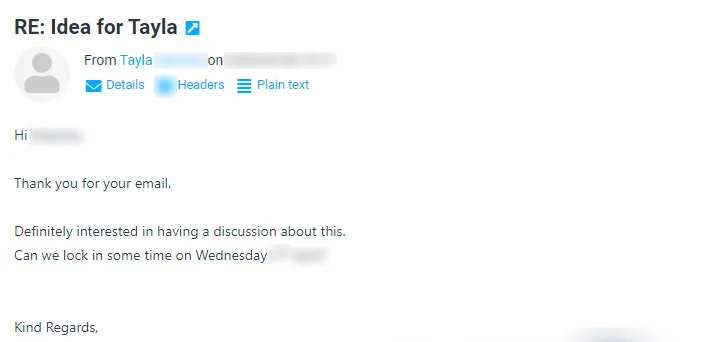
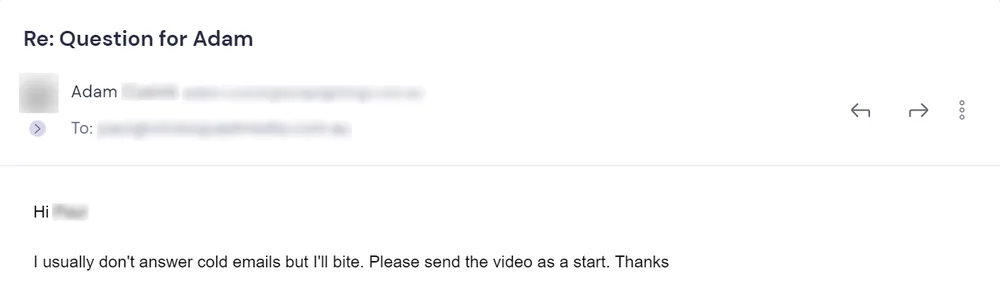
The same offer means different things to an owner, department head and finance lead. Clear beats clever. Here's what comes back.

Get replies like these

5 questions, about a minute.

You won't become the thing you delete every morning

You might be reading this thinking you don't want to be that guy. Neither do I.

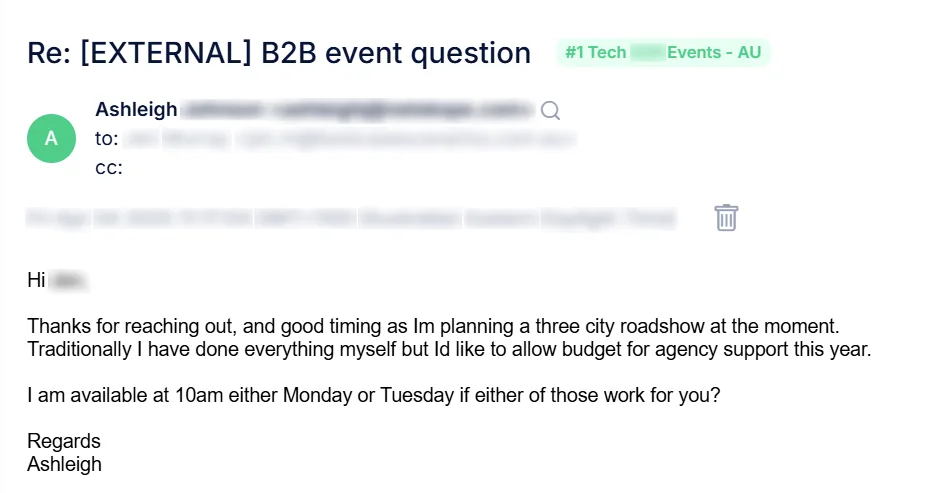
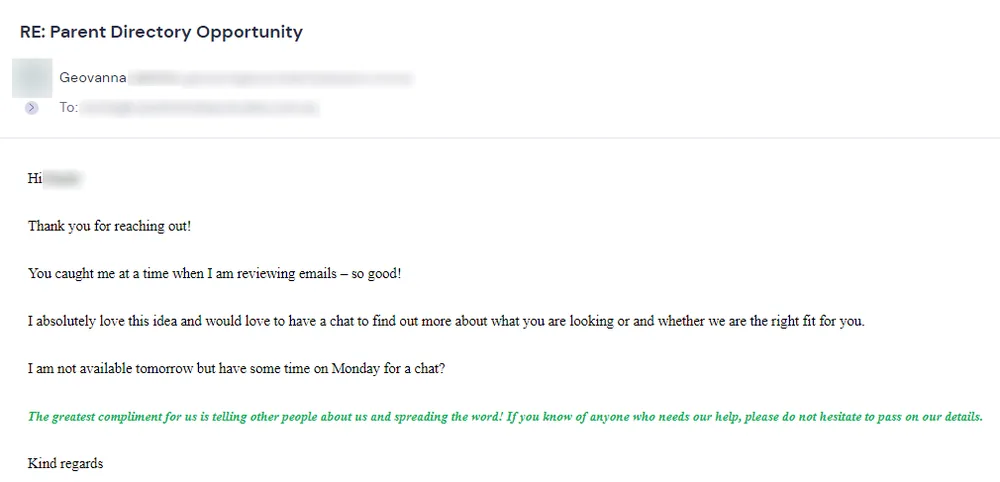
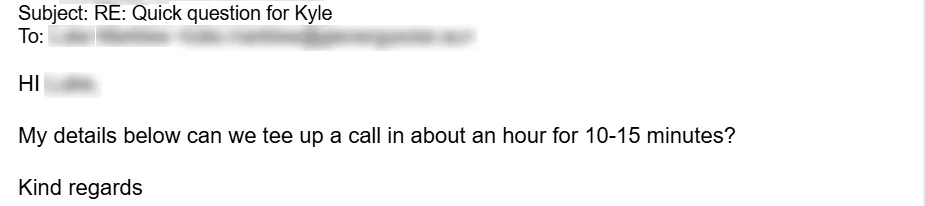
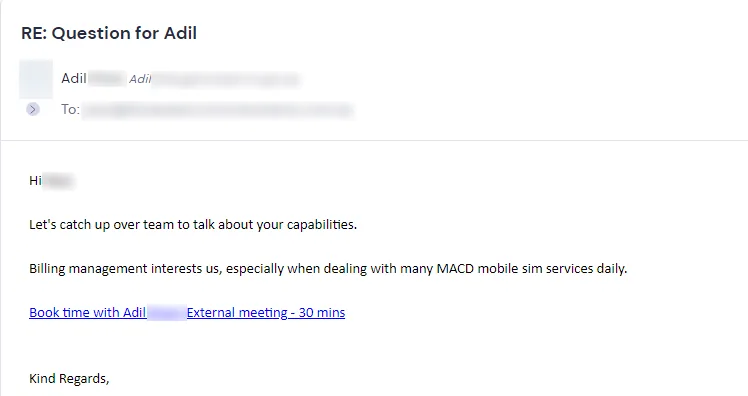
I've already told you where the risk sits and how we keep it away from the address your invoices go out from. So I'll just point at the wall of replies above, because it makes the point better than I can. Those aren't people being harassed. They're people who got a relevant email at a sensible moment from a company they'd never heard of, and chose to write back. The difference between that and the rubbish in your spam folder isn't the channel. It's whether anybody did the work first.

Apply for a call

You'll get the price on that first call.

The 90 days is the review period, not the wait

Setup sits outside the campaign clock, then we test, learn and expand in stages.

Setup takes roughly 10 to 15 business days. We agree the audience, economics, exclusions and messaging. You approve representative samples while we build domains, Microsoft 365 inboxes, DNS, warm up, sending controls and monitoring.

Day 1 is launch. We start with controlled slices rather than the whole market. Through the 90 campaign days, replies and sales feedback tell us which audience and message combinations deserve more attention.

Around Day 76 we review the evidence so far and agree what continues, changes or stops after Day 90. After that, the Sprint continues month to month for as long as it's earning its keep.

The Pipeline Sprint timeline Setup takes ten to fifteen business days and sits outside the campaign clock. Day one is the first approved send. Day seventy six is the evidence review, day ninety is the full results review, and the campaign continues month to month after that. SETUP 10 to 15 business days DAY 1 First email sends DAY 76 Evidence review DAY 90 Full review ONGOING Month to month CLOCK HASN’T STARTED 90 CAMPAIGN DAYS
The Pipeline Sprint timeline Setup takes ten to fifteen business days and sits outside the campaign clock. Day one is the first approved send. Day seventy six is the evidence review, day ninety is the full results review, and the campaign continues month to month. SETUP 10 to 15 business days DAY 1 First approved email sends DAY 76 Review the evidence DAY 90 Full results review ONGOING Month to month 90 CAMPAIGN DAYS outside the clock

One professional services firm signed three clients in 17 days. Another had four in the first three weeks.

Client result screenshot reporting three new clients signed in seventeen days.
A professional services firm signed three clients in seventeen days.
Client feedback screenshot reporting four clients in the first three weeks.
Four clients in the first three weeks.
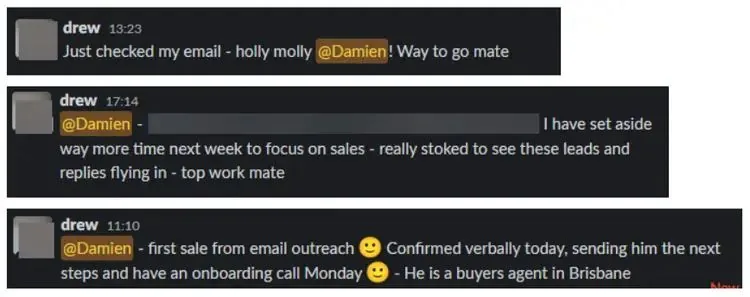
Client messages reporting a first sale from email outreach and five clients.
First sale from email outreach, then five clients.
Start the 90 days

5 questions, about a minute.

A copywriter who understands deliverability, backed by a delivery team

Most outbound is run by people who understand sending but not selling, or copy but not deliverability.

My background is in copywriting, including work with Scott Pape and Tim Reid. I lead the targeting and message. The delivery team monitors infrastructure, handles replies and keeps the campaign moving, with a named person for day-to-day work.

We've also been HubSpot partners for more than ten years, so the handover can fit the system your team already uses.

Approved historical CLCK B2B clients and partners.

Great copy is not easy to come by, and trying to write it is the bane of many small business owners' lives. So, my advice is to use Damien. He writes good. Real good. He did so for me and the results were wonderful.

Tim Reid, host of Small Business Big Marketing

Damien's been a bit of a secret weapon for me. He's helped me look really good and brought me some great results.

Eugene Soh

We regularly achieved more solid leads in a week using the CLCK approach than we had been receiving on an annual basis.

Brian Mulcahy

Whether this is a fit for you

Five or more staff and a deal around $15,000 are useful signals, not blunt gates.

It fits well if you're an Australian B2B business with five or more staff. There's no upper limit. A new client should be genuinely worth having, ideally around $15,000 or more, so the maths works comfortably.

We'll consider smaller deals, including under $5,000, when the offer or market depth justifies the test. Somebody at your end must pick up a warm reply within a few days.

It doesn't fit if you sell to consumers, want fifty names a week in a spreadsheet, or can't respond to interest quickly. It also doesn't fit if you need certainty. There is no guaranteed meeting number or sales outcome.

The price moves with market size and scope. You'll get it on the first call. If I don't think this can work in your market, I'll say so and we'll stop there.

I think this fits. Let's talk.

5 questions, about a minute.

Questions you're probably asking

The questions that usually stop people are the first four, so they're at the top and already open.

Will this hurt our domain?

Your main domain never sends a cold email. We use separate infrastructure and monitor it daily. Nobody honest will tell you the risk is zero because the email providers control the filters.

How long are we committed for?

The initial Sprint is 90 campaign days. That gives us time to warm the infrastructure, test in stages and learn something reliable. After that it continues month to month.

What if we decide to stop?

Then you stop. The domains, inboxes, campaigns and data are yours, and we document the handover.

How soon will we see something?

Setup and warm up usually takes 10 to 15 business days, then the campaign clock starts. Some campaigns here produced replies in the first fortnight. I can't promise yours will.

How is this different from the AI SDR tool that burned us?

Those tools pointed AI at volume and walked away. We build the message with you, sort the market first, test in stages and put a named human on your account.

So AI writes the emails?

No. We build the angle, hook, proof, ask and objection handling with you. AI sorts ten thousand companies, applies the right approved version and writes the observational opening from what each company does.

A person spot-checks samples before a list goes live. We won't pretend a human reads every variation at real volume.

Do we need a CRM?

No. We can work with HubSpot, another CRM or no CRM. We won't make you migrate anything you don't want to migrate.

What do you actually need from us?

Approve the targeting and messaging, respond to qualified replies quickly and tell us what happened. Without that feedback we're optimising in the dark.

More results, from other markets

These are historical outcomes, not promises about what your market will do.

An online business directory closed fifteen new clients in three months. A B2B software company put 131 interested decision makers in front of its sales team asking for demos. A recruitment firm signed six clients from twenty positive replies inside fifteen days.

A commercial solar business got sixteen real opportunities and eleven quotes booked in under three weeks. A commercial cleaning company landed an annual contract worth $41,840. One client signed two contracts straight from cold email, one at US$7,500 and one a $1,000 audit. Another had a meeting booked and a proposal out before lunch, then a signature and a second proposal.

None of those are forecasts. They're what happened.

How to find out whether it works in your market

Five questions lead to one direct 30 minute call.

I'll ask about your numbers, market and what you've tried. I'll tell you whether I think it can work. You'll get the price on that first call, no dance and no second meeting just to hear a number.

Do you run a B2B service business in Australia with 5 or more staff?

Yes

If you take one thing away, take this

Every reply comes from a company you already decided you wanted.

338 contacts, 15 meetings, $185,000 in pipeline. Three clients in a month. Ten for a recruiter. Fifteen in three months for a directory.

If you're an Australian B2B business with five or more staff, a new client is genuinely worth having and somebody can pick up the phone when interest lands, it's worth half an hour to find out whether this works in your market.

Care for Kids partnered with CLCK to build a brand new database and lead generation strategy. Damien and his team were brilliant to work with, incredibly thorough, responsive, and adaptable. I would absolutely recommend CLCK for their ability to move fast, build bespoke lead generation strategies, and above all else be a great extension of your team.

Emily Woods, Care for Kids

After a disappointing experience with another company, I was feeling pretty sceptical about lead generation. But when I spoke with Damien, his sincerity and the CLCK model really resonated with me. I felt like they understood my challenges and were committed to helping me find and engage with the right leads for my business.

The targeted campaigns CLCK created for me were a game-changer. They took the time to listen to my concerns and suggestions, and it showed in the results. Within the first month of our first campaign, I started securing clients, which was a huge relief after feeling lost for so long.

I tell other businesses that CLCK will not only identify potential clients but also help set up that initial connection. After that, it's up to you to showcase what you have to offer.

Mary B, Managing Director, Calculated Solutions

Damien Elsing
CLCK

P.S. Other channels ask the market to find you. Here, you write the list. If somebody replies, they're a company you already decided you wanted.

Apply for a call

5 questions, about a minute.